Twelve USDT from a small job, or three tips of 4 USDT each, sitting in your Binance account. The money is real and it’s yours, yet both exits look shut: the withdrawal screen mentions a minimum, and every buyer on the P2P sell list wants an order worth far more than you have.
Nothing went wrong with the payment. A small balance can sit under two separate floors at once: the minimum withdrawal for the network you choose, and the lower order limit each P2P buyer puts on their ad. Under both, the cheapest move is usually to leave it in the account until the next payment lifts the total over a P2P limit, then sell once. If small payments are going to keep coming, agree with the payer to send them in batches.
Why Binance won’t let you withdraw a small USDT amount
Each network has its own minimum withdrawal and its own flat fee, and both are listed on Binance’s public Crypto Deposit & Withdrawal Fees page. Searching that page for USDT on 22 November 2026 brought up 19 networks. Here are the ones payers tend to use, with what a 6 USDT withdrawal would leave after the fee:
| Network | Minimum withdrawal | Withdrawal fee | 6 USDT leaves your balance, about this arrives |
|---|---|---|---|
| Tron (TRC20) | 5 USDT | 2 USDT | 4 USDT |
| BNB Smart Chain (BEP20) | 2.6 USDT | 0.01 USDT | 5.99 USDT |
| Polygon POS | 5 USDT | 0.03 USDT | 5.97 USDT |
| Arbitrum One | 3 USDT | 0.3 USDT | 5.7 USDT |
| The Open Network (TON) | 3 USDT | 0.3 USDT | 5.7 USDT |
| Ethereum (ERC20) | 5 USDT | 0.6 USDT | 5.4 USDT |
| Solana | 5 USDT | 0.7 USDT | 5.3 USDT |
Read the Tron row twice. It is the network many payers pick for USDT, and its fee is a flat 2 USDT: a third of a 6 USDT withdrawal, a fiftieth of a 100 USDT one. A flat fee is cheap on large amounts and expensive on small ones, which is the whole problem in one line.
The cheaper rows only help if the other end accepts USDT on that network. Before choosing BNB Smart Chain because its fee is 0.01, check that the wallet or exchange you’re sending to lists the same network on its own deposit screen. The fee page also warns that withdrawal rates “can fluctuate without notice due to factors such as network congestion” and tells you to check the withdrawal page itself, so the figure on your withdrawal screen is the one to go by on the day.
There’s a quieter catch too. Withdrawing doesn’t turn USDT into local money. It moves it to another platform, where you’d still have to sell it under that platform’s own minimums. Paying 2 USDT to move 6 USDT somewhere that also won’t buy 4 USDT gets you nowhere.
Why no P2P buyer will take a small amount
On P2P you sell into a buyer’s ad, and every ad has an order limit in local currency: a lower and an upper figure in the “Available/Order Limit” column. An order below the lower figure can’t be placed on that ad.
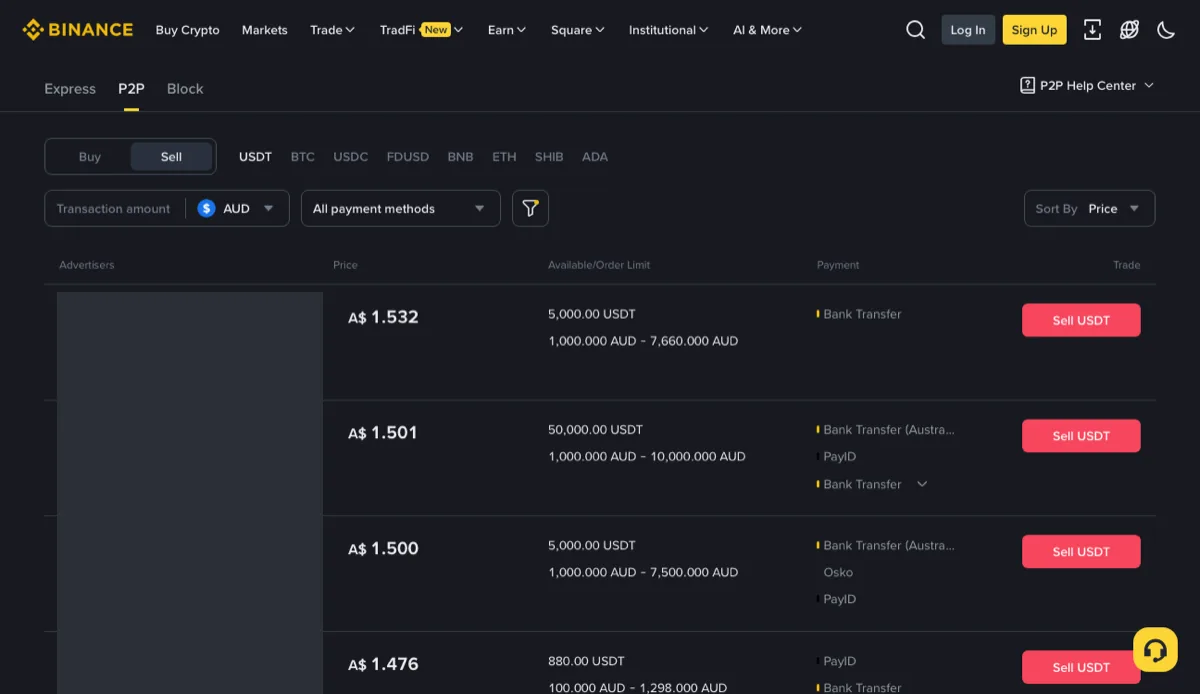
When we opened the public Sell USDT page it showed Australian dollar ads. On the first screen, most lower limits were 1,000 AUD, and the smallest was 100 AUD at a price of A$1.476, which works out at roughly 68 USDT. The currency you see, the ads and their limits will all differ from this, and they move through the day.
So the practical check is short. Pick your currency and payment method, then run down the Order Limit column looking for a lower figure under what your USDT is worth. There’s a [Transaction amount] box above the list for entering the sum you want to sell. If nothing fits, no buyer on that list is taking an order that small right now; trying again at another time of day, or with another payment method you hold in your own name, may change that.
When you do find an ad, the selling rules don’t get lighter because the amount is small. Release only when the full payment is in your own bank or wallet app; selling USDT on Binance P2P for the first time walks through that moment.
Small Amount Exchange: for crumbs, not for cash
Binance has a tool for small balances, and it’s easy to assume it solves this. It doesn’t, quite. The help page How to Convert Small Account Balance (updated 5 August 2026) describes [Small Amount Exchange], reached from [Assets] → [Spot]. It converts balances valued below 20 USDT into BNB, BTC, ETH, USDT or USDC, once every hour, and “a flat 2% fee applies to all token conversions, except alpha tokens which have a 10% flat fee charged”. What you get back lands in your Spot account.
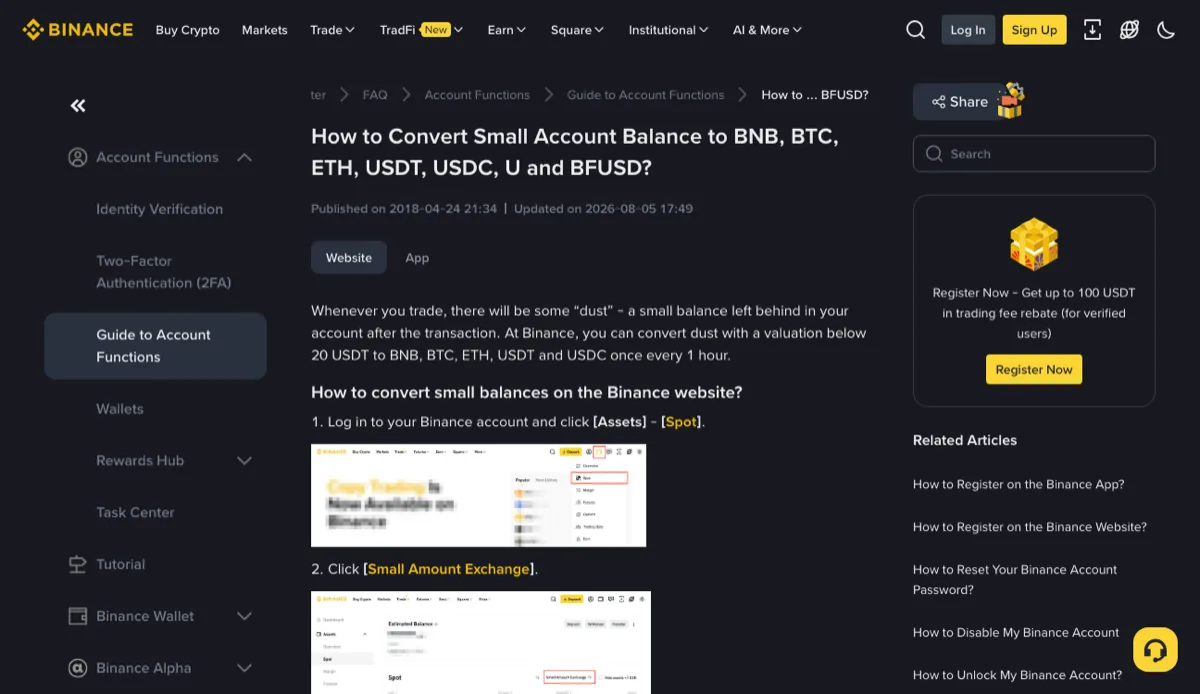
That makes it the right tool for leftovers: 0.37 USDT stranded after a P2P sale, or a small amount of another coin you were paid in that you’d like gathered into USDT. It isn’t a way to cash out a small USDT balance. Even if your USDT appeared in that list, turning 12 USDT into BNB would leave about 11.76 USDT worth of BNB after the 2%, which is no easier to sell.
What to do with a balance stuck under both floors
Leaving it is a legitimate choice, and usually the cheapest. A small balance can stay in your account; when the next payment lands on top of it, the total may clear a P2P lower limit and you sell in one order instead of two. The cost of waiting is that you’re holding USDT rather than your own currency for a while. If you can’t afford any wobble in what it’s worth, or need the money this week, read keeping your pay in USDT or converting it before deciding.
If you’d rather withdraw, treat it as one considered withdrawal, not several small ones:
- Open the deposit screen on the receiving side first and note which USDT networks it lists.
- On Binance’s withdrawal screen, pick a network from that list and read the fee and the amount that will arrive.
- Check the receiving platform’s minimum deposit and its own selling minimums before you send. If either is above what will arrive, stop there.
And for payers who are also on Binance, there’s a way to keep small amounts from shrinking on the way in. A transfer with Binance Pay goes between two Binance accounts without touching a blockchain, so there’s no network fee, and any fee is shown on the Pay screen before the sender confirms. Binance Pay ID or deposit address covers what to give them. It won’t make the balance big enough to sell, but it stops a 2 USDT fee being taken out of a 6 USDT tip.
Agree a payout threshold with whoever pays you small amounts
When small payments are regular, such as per-task work, tips or a client who pays item by item, the fix belongs in the arrangement with the payer. Ask to be paid in batches: once a week, once a month, or when what’s owed reaches a set figure. Set that figure from your own P2P list, at or above the lower limit of the ads you’d realistically sell into. Batching also means the payer meets their withdrawal fee once instead of every time, which matters if you’ve agreed who pays the transfer fee and it’s them.
Asking a regular payer to batch small amounts
Could we batch the small payments? Please hold anything under [50] USDT and send it together with the next amount, or on [the 1st of each month], whichever comes first. Same details as before: USDT on [network] to [address]. Fees paid by the sender, so the full amount arrives.
Batching does mean money owed to you sits with the payer for longer, and that’s a real cost with someone new. For a first few jobs with an unfamiliar client, getting paid promptly is worth more than saving a fee, and the threshold can come later, once they’ve paid on time a few times.
Where these figures come from checked 22 November 2026
Minimum withdrawals and withdrawal fees come from Binance’s public Crypto Deposit & Withdrawal Fees page, searched for USDT. The Small Amount Exchange rules (20 USDT ceiling, once an hour, 2% fee, target coins) come from the help page How to Convert Small Account Balance, updated 5 August 2026. The order limits come from Binance’s public P2P Sell USDT page, opened without signing in. The 6 USDT column and the 68 USDT conversion are our own arithmetic from those figures.