Ask for the one you can sell for your own currency without a detour, on a network that both you and the person paying you support. Many payers reach for USDT by default. Whether it is also the easier coin to sell in your currency is something you check on your own platform before you send payment details.
Everything else people argue about, such as which company is more transparent or which one is “safer”, matters less to you than those two practical points. You are not choosing an investment. You are choosing the format a payment arrives in, and you’ll probably convert most of it soon after.
What the two coins have in common
Start here, because the similarities rule out a few bad reasons to pick one.
Both are tokens meant to stay worth one US dollar, and both are issued by private companies: USDT by Tether, USDC by regulated affiliates of Circle. Each company says its tokens are fully backed. Tether’s transparency page says all its tokens are “backed 100% by Tether’s Reserves”; Circle’s USDC page says USDC is “backed 100% by highly liquid cash and cash-equivalent assets” and that it publishes monthly reserve attestations by a Big Four accounting firm. Those are the companies’ own statements. Neither is a bank deposit, and “designed to stay at one dollar” is not the same as a promise that it always will.
Neither one is something you, as an individual, can hand back to the issuer for dollars. Circle redeems USDC directly only through Circle Mint, and its own page says “Mint is not available to individuals or small businesses.” Tether’s terms say you must be “a verified customer of Tether” to redeem, subject to minimum amounts and fees that the terms don’t put a number on. In practice, whichever you receive, you’ll turn it into local money the same way: by selling it on an exchange or to a buyer on a P2P market.
Both issuers can also freeze tokens. Tether’s terms of service reserve the right to freeze Tether tokens and blacklist addresses (sections 2, 8 and 16). Circle’s USDC terms say Circle “reserves the right to block the transfer of USDC to and from an address on chain” and may have to freeze USDC under a valid government order (section 13). For an honest payment this is unlikely to touch you, but it is the reason a stablecoin from a stranger paying over the odds deserves a closer look, whichever coin it is. Whether a payment can be taken back goes into that.
The network question decides more than the coin
Here’s the difference that actually causes lost payments. The two coins don’t run on the same set of networks, so a route that works for one may not exist for the other.
USDT is widely sent on TRON, and that’s why so many payers default to it. USDC isn’t. Circle’s USDC page lists the blockchains where USDC is natively issued, 38 of them as of 16 September 2026, from Ethereum, Solana, Base, Arbitrum and Polygon to Stellar and Algorand. TRON is not on that list, and neither is BNB Smart Chain. A token called “USDC” on a network outside Circle’s list is either a version issued by someone else, or not one your account will accept for that network at all.
What this means when someone offers USDC:
- If they say “USDC on TRON”, stop and ask again. It is most likely a mix-up with USDT, and money sent to a route your deposit page doesn’t list may not be credited.
- If they’re paying from an exchange, the networks their withdrawal screen offers for USDC may differ from the ones it offers for USDT. Ask them which networks they see for the coin you’ve agreed on.
- Fees follow the network, not the coin. The sender pays the network fee, and on some networks that fee is small while on others it can eat noticeably into a small payment. Who pays the transfer fee explains how to agree on it.
On your own side, the deposit page is the only list that counts. Open it, choose the coin, and read the networks it shows for that coin. Then pick one that also appears on the payer’s list. If the two lists don’t overlap, you can’t use that coin for this payment without someone converting first.
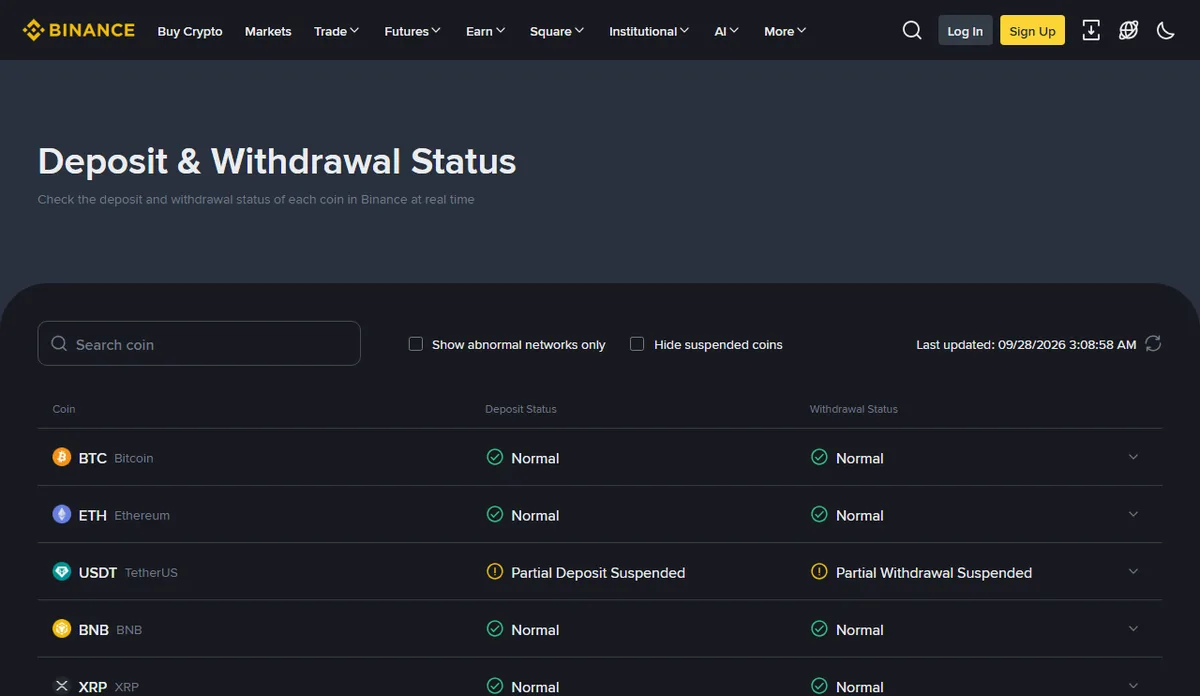
A network can also be temporarily switched off for deposits. Exchanges post these pauses on a status page like the one above. A quick look before you send your details saves a payment that sits in limbo.
Can you sell it where you live?
This is the question that decides it for most people, and you can answer it in a few minutes without spending anything.
Open the P2P market on the platform you use (on some exchanges the ad list is public, so you can look before signing in). Set the fiat currency to yours, choose “Sell”, and switch the coin between USDT and USDC. Look at three things:
- Are there buyers at all? In some currencies one of the two coins has plenty of ads and the other has few or none.
- The payment methods. An ad that only accepts a bank or wallet you don’t have is no use to you. Count the ones you could actually receive money through.
- The gap between the two prices. Ads for the less traded coin often sit further from the market rate. That gap is a cost you pay on every conversion.
If your currency has a busy USDT market and a thin USDC one, being paid in USDC means either selling into a thin market or converting USDC to USDT first on the exchange, which is one more trade and one more spread. The reverse is also possible in some places. The point is to look, for your currency, before agreeing.
If you’ll keep some of the payment as a stablecoin for a while rather than selling it, that’s a different decision with different risks. Keeping pay in USDT or converting it covers it from a receiver’s side. The coin you hold doesn’t remove the main risk of holding either.
What these points rest on checked November 2026
Issuer, backing and redemption statements come from Circle’s USDC page (including the list of 38 natively supported blockchains dated 16 September 2026) and Tether’s Transparency page. Freezing and redemption terms are from Tether’s Terms of Service (sections 2, 4.1, 8 and 16) and Circle’s USDC Terms (sections 2 and 13). The points about deposit pages and the status page rest on the deposit help page cited in the account-opening guide. We didn’t log into any account or trade either coin for this guide.
When the payer can only send one of them
Often the choice isn’t really yours. A client’s company may hold only USDC, or an employer’s payroll provider may pay in one coin. Then the job is to make the coin they have work for you:
- Check it fits your deposit page first. Same steps as above: coin, then network, then status.
- Price in the conversion. If you’ll have to swap it into the other coin before selling, that swap has a fee or spread. On a large or recurring payment it’s reasonable to raise it, or to agree an amount that accounts for it. Put the agreed coin in writing.
- Don’t let them switch coins mid-stream. If the first invoice said USDC on Solana, a later “I sent USDT instead” is a different deposit. Check it as a new payment before you count it.
A short message keeps the coin and route explicit:
Confirming the coin and network
Thanks. To keep it simple: please send [USDT / USDC] on the [network name] network, to the address below. Please don't switch to a different coin or network without checking with me first, because my account only accepts this exact combination at this address.

[address]
The full list of what to send your payer adds the amount, the reference and the test payment. If you invoice, write the coin and network on the invoice itself; the invoice maker has a field for each, so choose a network that actually carries the coin you picked.
A quick way to decide
Run these in order and stop at the first one that settles it:
- Which coins and networks can the payer send from where they hold the money?
- Which of those does your deposit page list, and are deposits open for that network today?
- For your currency, which coin has buyers using a payment method you have?
- If both pass, take the one that needs fewer conversions before it becomes the money you spend.
When the first payment of a new coin or network lands, check it with its transaction ID rather than a screenshot. Checking a payment arrived walks through it.