Redeem a Binance gift card only inside your own verified Binance account, never on any other site and never through another person. In the app, go to [More] → [Gift Card] → [Redeem] → [Redeem to crypto], type the 16-character code and press [Redeem]. The value is credited to your Spot or Funding wallet straight away.
Treat the code the way you’d treat cash in an envelope. Whoever types it first gets the money, and Binance’s rules mean it can’t be split, reused or pulled back once redeemed. So until you’ve redeemed it yourself, the only person who should see it is you.
How to redeem, on the app and the website
You need a Binance account that has completed identity verification. Binance’s help page is direct about this: “Only verified Binance users can redeem gift cards on Binance.” If you don’t have an account yet, or you signed up but never finished verification, do that first. The guide to opening and verifying a Binance account covers it, and the code will still be there when you’re done, as long as it hasn’t expired (more on that below).
In the Binance app:
- Open the app yourself, not from a link someone sent you.
- Tap [More], then [Gift Card].
- Open the [Redeem] tab and choose [Redeem to crypto].
- Type or paste the 16-character code.
- Tap [Redeem].
On the website:
- Go to binance.com by typing it or from your own bookmark, and log in.
- Scroll to the bottom of the page and click [Gift Card].
- Enter the code in the Redeem box.
- Click [Redeem].
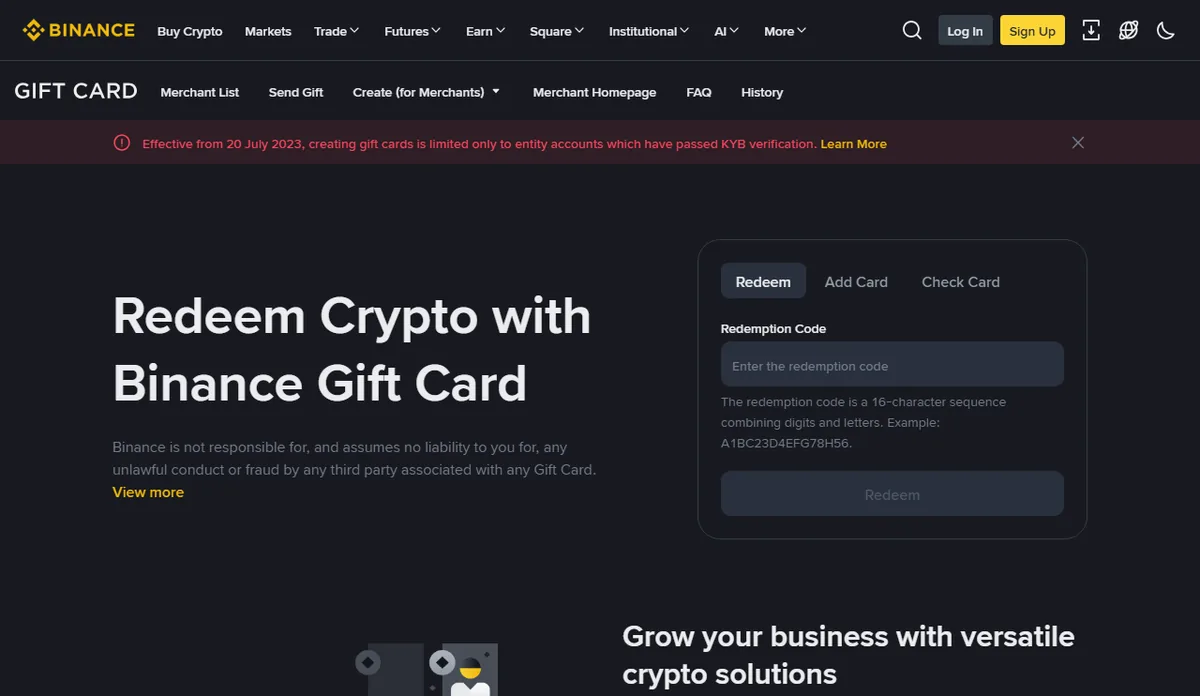
Binance says the amount is credited immediately, to your Spot or Funding wallet. If you don’t see it in one, look in the other before worrying. The same gift card page also has tabs called Add Card and Check Card alongside Redeem.
On cost, Binance’s page says: “Sending and redeeming Binance Gift Cards are free of charge at the moment.” Note the last four words. If you later convert what you received into something else, the normal trading fees for that trade apply, and if you sell for local money, the price you get in the market is its own cost. The guide on whether to keep USDT or convert it goes through that choice.
If the code is rejected, check it character by character before trying again. Characters that look alike are easy to mix up when a code is copied by hand from a photo or a message. If it still fails, go back to the person who sent it: the card may already have been redeemed, or it may have expired. Don’t hand the code to anyone who offers to “try it for you”.
What a Binance gift card can’t do
A gift card is a one-time code for a fixed amount, and it can’t be split. Binance’s help page says a card is redeemed for its full amount only: there’s no partial redemption, so you can’t take half now and leave the rest on the card.
It can expire. Cards created on or after 10 April 2024 expire 6 months after they were created. Cards created before that date have no expiry. The date that counts is when the card was created, not when you received it, so a card someone had in a drawer for months may be close to the end. If you’re given one, redeem it soon.
It’s a one-time code. Once redeemed by anyone, it’s used. There’s no “undo”, and there’s no way to move the value back onto the card.
It usually comes from a business, not a friend’s account. Binance’s public gift card page carries a notice: “Effective from 20 July 2023, creating gift cards is limited only to entity accounts which have passed KYB verification.” KYB means “know your business”, the identity checks for companies. In practice, new Binance gift cards are created from verified company accounts, not from an individual’s personal account. So a card that reaches you most likely started with a business, even if a person passed it on.
That matters when someone says they’re paying you with one. A relative who wants to send money home can’t create a gift card from their own personal Binance account, so a gift card is rarely the simple route for family money. The guide on sending family money through USDT or a remittance app compares the options. And if a client, employer or buyer insists on paying you by gift card instead of a normal transfer, ask why. It isn’t automatically a scam, but it’s unusual enough to slow down.
Where this comes from checked September 2026
The redemption steps, the verified-user requirement, the full-amount rule, the expiry dates and the note on fees come from Binance’s help page How do I redeem a gift card on Binance? (updated November 2024). The notice about entity accounts and KYB, the tab names and the fraud disclaimer are from Binance’s public gift card page as it appeared in September 2026.
Red flags: when a gift card is a trap
The code is the value, so gift card scams are nearly all ways to make you reveal the code or type it somewhere other than your own Binance account. These are the requests to refuse:
- “Read me the code so I can check it’s valid.” Anyone who has the code can redeem it. There is no reason for the sender, a buyer, or “support” to need it back.
- “I’ll verify the card for you” or “send me a photo of the card so I can confirm it’s real”. Same trick with different words.
- “Redeem it on this site” or “log in through this link to claim it”. The only place to redeem is Binance itself, opened by you. A look-alike page that asks for the code, your login or your security codes is there to take them.
- “The card is worth more than you’re owed, so send me back the difference.” This is an overpayment scam. You send real money back, then discover the card was already redeemed, invalid, or never existed.
- “Buy a gift card and send me the code to release your payment.” Legitimate payers don’t ask you to pay to be paid. Anyone demanding a code upfront, for a fee, a tax or an “activation”, is the scam.
- A message from “Binance” saying a card is waiting for you, with a link. Ignore the link; log in yourself and look.
Binance’s gift card page is clear about where its responsibility ends. It states that Binance “is not responsible for… any unlawful conduct or fraud by any third party associated with any Gift Card.” In plain terms: if you’re tricked into giving the code away, don’t expect the platform to put the money back.
If you’ve already shared a code, redeem it yourself immediately if you still can; if it’s already gone, report the person through Binance’s support inside the app, and stop contacting them. The guide on fake crypto payment proof covers the related trick of “proof” that a payment or card was sent when it wasn’t.